History of Gymnastics
Gymnastics is one of the oldest sports in the world and has always been closely linked with the development of the human body, discipline, and physical culture. The history of gymnastics is not just about sport; it is about how societies across centuries valued strength, balance, flexibility, and grace as an essential part of life.
Early Origins
The roots of gymnastics can be traced back to ancient civilizations. The very word gymnastics comes from the Greek word gymnazein, which means “to exercise.” In ancient Greece, physical training was considered as important as mental development. Young men were trained in gymnasiums, which were public places of exercise, education, and social interaction. Greek gymnastics included running, jumping, wrestling, and acrobatics. It was not only for competition but also to prepare citizens for military life and to create a healthy, disciplined society.
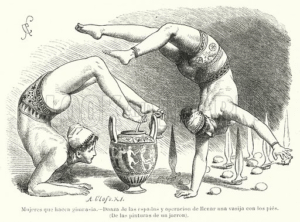
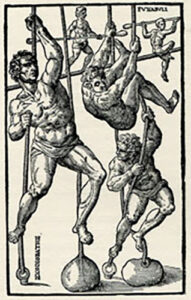
The Romans carried forward these traditions from the Greeks. However, they modified gymnastics to suit their military needs. They practiced activities that focused on strength, marching, tumbling, and acrobatics. For the Romans, physical training was directly connected to building strong soldiers. Acrobatics also became part of entertainment in circuses and festivals during that period.
Decline and Revival
With the fall of the Roman Empire, gymnastics and many other physical activities declined in Europe. For many centuries, structured physical training was not given much importance, although tumbling and acrobatic displays continued as part of entertainment. It was only during the Renaissance period in the 15th and 16th centuries that people once again began to value the human body and physical education.
This revival gave birth to modern gymnastics. In the 18th and 19th centuries, several educators and physical trainers in Europe designed systems of exercise to build strong and disciplined individuals.
Birth of Modern Gymnastics
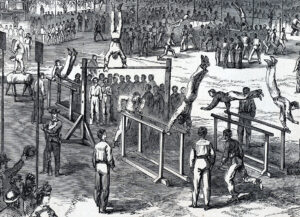
The person who is remembered as the “Father of Modern Gymnastics” is Friedrich Ludwig Jahn of Germany. In the early 1800s, he created several apparatus that are still used in gymnastics today, such as the horizontal bar, parallel bars, rings, and balance beam. Jahn believed that gymnastics was not only a way to make the body strong but also a way to build national pride and unity.

At the same time in Sweden, Per Henrik Ling developed a system of free-hand exercises and movements without apparatus. His method focused on health, flexibility, and overall physical well-being. These two traditions—apparatus-based German gymnastics and free-hand Swedish gymnastics—spread across Europe and the world, influencing schools, colleges, and sports clubs.

Gymnastics Becomes a Sport
As gymnastics became popular in Europe, gymnastics clubs and societies were formed. The sport gradually turned into a competitive activity. The first modern Olympic Games held in Athens in 1896 included men’s gymnastics as a key event. Women’s gymnastics was later added in 1928 at the Amsterdam Olympics.
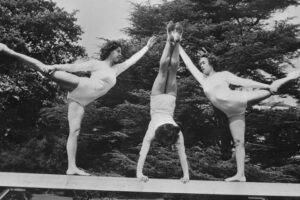
From there, gymnastics spread worldwide and continued to grow as a professional sport. Over time, new disciplines such as artistic gymnastics, rhythmic gymnastics, and trampoline gymnastics were introduced, each adding new elements of beauty, flexibility, and creativity.
Gymnastics Today
In the present day, gymnastics is not only about competition. It is a sport that builds discipline, confidence, focus, and physical strength in children and adults alike. It is admired worldwide because it combines athletic power with artistic beauty.
Internationally, gymnastics is governed by the Fédération Internationale de Gymnastique (FIG), which was founded in 1881 and is one of the oldest international sport federations. Gymnastics continues to be one of the most watched and celebrated sports in the Olympic Games.

From its beginnings in ancient Greece to its modern form today, gymnastics has traveled a long journey. It has survived through ages of decline and revival, and it continues to evolve as a sport that inspires millions. For young athletes, it teaches balance, flexibility, courage, and determination—values that remain with them for life.
Gymnastics in India
Gymnastics in India has a journey that is both inspiring and challenging. While it may not yet enjoy the same popularity as cricket or athletics, the sport has steadily grown from a small presence during the colonial period to international recognition in recent years. The story of Indian gymnastics is one of passion, perseverance, and gradual progress.
The beginning of gymnastics in India can be traced back to the British colonial era, when physical education was introduced in schools. Along with other sports, gymnastics found its place in the training programs of schools and colleges, mainly in large cities like Calcutta, Bombay, and Madras. In those days, gymnastics was not seen as a professional sport but rather as part of fitness and discipline training. Small clubs were formed, and enthusiasts kept the practice alive, but the sport did not spread widely due to lack of infrastructure, equipment, and expert coaches.
A turning point came in 1951, when the Gymnastics Federation of India (GFI) was established. This gave the sport an official governing body that could organize national championships and represent India at the international stage. GFI’s affiliation with the Fédération Internationale de Gymnastique (FIG) connected India with the global gymnastics community. For the first time, Indian gymnasts began participating in Asian and world competitions, though the results were modest in the early years.

Over the decades, India made slow but steady progress. Participation in the Asian Games and the Commonwealth Games gave Indian gymnasts valuable exposure, even though competing against powerhouses like China, Japan, and Russia was always a tough challenge. The real breakthrough came in the 21st century, when Indian gymnasts started winning medals at major international events.
One of the proudest moments came at the 2010 Commonwealth Games in Delhi, when Ashish Kumar created history by winning India’s first-ever gymnastics medals – a silver in vault and a bronze in floor exercise. His achievement inspired many young athletes and proved that India could compete at the highest level.

However, the true face of Indian gymnastics for the world became Dipa Karmakar from Tripura. At the 2014 Commonwealth Games in Glasgow, she stunned everyone by winning a bronze medal in vault, becoming the first Indian woman to achieve this feat. Two years later, at the 2016 Rio Olympics, she performed the highly dangerous Produnova Vault and finished fourth, narrowly missing out on a medal but winning global respect. Dipa’s courage and dedication turned her into a household name and brought gymnastics into the national spotlight.

Other gymnasts like Rakesh Kumar Patra and Pranati Nayak have also carried the flag forward, with Pranati winning a bronze medal at the 2021 Asian Championships. These achievements highlight the growing potential of India in a sport once considered far beyond its reach.

Yet, the path has never been easy. Gymnastics in India continues to face many challenges – shortage of modern training facilities, lack of professional coaches, limited exposure for young gymnasts, and uneven development across states. Some regions like Tripura, Maharashtra, and Haryana have produced exceptional talent, while many other parts of the country are still waiting for proper infrastructure.
Despite these obstacles, the spirit of Indian gymnastics is alive and strong. The government’s initiatives, such as Khelo India, along with the efforts of district and state associations, are now helping identify and nurture young talent from the grassroots. With better facilities, international exposure, and continuous support, the future holds promise.
The journey of gymnastics in India is far from over. From its quiet beginnings in colonial schools to the electrifying performances at the Rio Olympics, it has been a story of resilience and hope. Indian gymnasts have shown that with determination, they can stand shoulder to shoulder with the best in the world. With the right support, India can truly become a strong force in global gymnastics in the years ahead.